
In 1952, a telescope in California stared up at the heavens and captured a lie. At least, that’s what it looked like: a star appeared, burned itself onto the glass, and then was never seen again. No one at the Palomar Observatory thought much of it at the time. The night sky was full of tricks — cosmic rays, dust, flickers from passing meteors. But seventy years later, one Swedish astronomer has gone back to those plates and declared, in essence: something up there is not adding up.
Welcome to the work of Dr Beatriz Villarroel, the scientist behind one of the strangest new frontiers in astronomy — a study that peers into old sky photographs and finds lights that shouldn’t exist. Her conclusion is that something odd has been happening above our heads since long before the first man-made satellite ever left the Earth.
The detective of disappearing stars
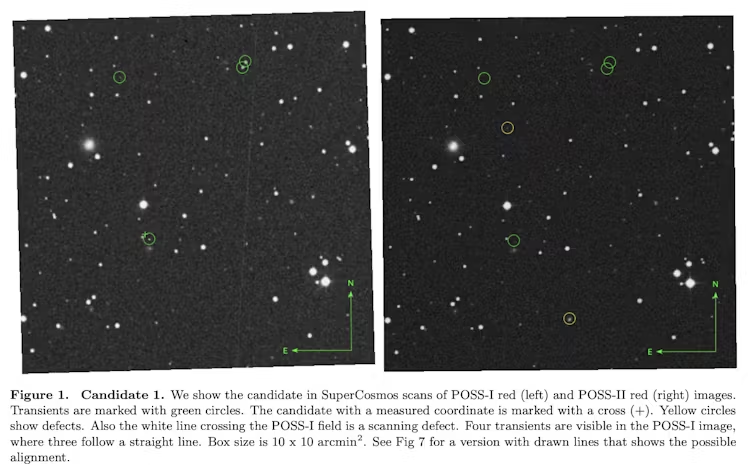
Dr Beatriz Villarroel, an assistant professor at Nordita (the Nordic Institute for Theoretical Physics in Stockholm), leads a project with a wonderfully gothic name: VASCO, or Vanishing and Appearing Sources during a Century of Observations. Her team takes archival images of the sky — photographic plates from the 1940s and 1950s — and compares them to modern digital surveys. They look for stars that wink into existence and then vanish entirely.
Imagine taking a photo of the night sky from 1950 and comparing it to one from today, pixel by pixel. In some regions, Villarroel finds missing stars — points of light that once shone but are now gone. Sometimes they appear for only one exposure before vanishing forever. These “transients,” as astronomers call them, are not supposed to exist in such abundance. They are too many, too neat, too point-like.
In short: either the plates are lying, or the universe is.
The nuclear connection
The real twist in Villarroel’s latest paper, published in Scientific Reports in 2025, is her team’s unexpected correlation between these mysterious sky-lights and a very human activity — above-ground nuclear testing.
Her team combed through thousands of photographic plates from the Palomar Observatory Sky Survey (POSS-I), taken between 1949 and 1957 — a period that coincides neatly with the early atomic era. They catalogued every transient — every one-off light that appeared and disappeared — and then cross-referenced those dates with records of atmospheric nuclear tests.
The result? A pattern. On days within ± one day of a nuclear test, the chance of a transient appearing in the photographic data jumped by roughly 45 per cent.
If that doesn’t make your scalp tingle, it should. Because this isn’t a UFOlogist waving a blurry photo of a saucer — it’s a professional astronomer saying, “Statistically, there was more weird stuff in the sky when humans were detonating atomic bombs.”
The plot thickened further when Villarroel compared her data with UAP (Unidentified Anomalous Phenomena) reports — the newly sanitised, government-friendly term for UFO sightings. Her team found a smaller but still significant correlation: the more UAP reports on a given date, the more transients turned up in the astronomical record. Every extra UFO report corresponded to an 8.5 per cent increase in these rogue points of light.
It’s all correlation, not causation, of course — but it is exactly the kind of eerie numerical whisper that keeps scientists awake at night.
A sky before satellites
To grasp how strange this is, remember that the POSS-I survey predates Sputnik. There were no known artificial satellites orbiting the Earth at the time those photographs were taken. Anything reflecting sunlight overhead should have been natural — meteor trails, high-altitude balloons, maybe the odd bit of military debris.
But Villarroel’s transients are not streaks. They’re clean, round, point-like. They look exactly like stars. Yet they’re not where stars should be. Some last the duration of a 45-minute exposure and then never appear again.
If these are reflections, then something — perhaps metallic — was in a stable position long enough to gleam and fade. Which raises the unsettling question: what was orbiting Earth before humans put anything there?
This is where Villarroel becomes both thrilling and controversial. She doesn’t declare extraterrestrials. She doesn’t cry “ancient satellites.” But she also doesn’t rule it out. Her phrasing is calm, academic, deliciously ambiguous: the anomalies “could correspond to reflective objects in orbit before the space age.”
Translation: there might have been something already up there.
The sceptic’s whisper
Now, before you start polishing your tinfoil hat, let’s talk about the other side — the sceptical, earth-bound explanation.
Old photographic plates are notoriously temperamental. Dust specks, cosmic rays, emulsion scratches, and scanning artefacts can all mimic stars. Villarroel’s team applied careful filters and cross-checks, but some scientists argue the anomalies could still be defects rather than cosmic revelations. The sheer volume of data — tens of thousands of plates — makes it difficult to eliminate every false positive.
Then there’s the statistical danger: with so many data points, some correlation is almost guaranteed to appear. Nuclear tests were frequent in the 1950s, and sky surveys were conducted continuously; coincidences happen.
And yet — here’s the delicious tension — not every doubt cancels the wonder. The anomalies persist even after accounting for obvious noise. The transients really are there, flickering once and gone forever. If they’re artefacts, they’re stubbornly consistent ones.
Even the sceptics agree on one point: Villarroel’s data is worth investigating further. Because whether these are early-orbit objects, high-altitude plasma, or merely the ghosts of old photography, the question pierces the same nerve — how little we truly know about the sky we take for granted.
Is this proof of UFOs?
Here’s where things get spicy. Some corners of the internet — particularly those with a fondness for alien emojis and long YouTube monologues — have already hailed Villarroel’s findings as the smoking gun. Proof, they say, that there were unidentified craft observing humanity’s first nuclear flirtations. After all, many declassified U.S. military files show similar trends: UFO sightings spike around nuclear test sites, missile bases, and atomic labs. Are these lights the astronomical equivalent of those reports — the same watchers, caught on film from above?
Villarroel herself avoids that leap. She’s careful, almost maddeningly so. Her work doesn’t claim proof of anything extraterrestrial — only anomalies that don’t fit known explanations. Still, the idea has a strange pull. If something unknown was in orbit before Sputnik, the implications are vertiginous. Could an earlier civilisation — human or otherwise — have left artefacts circling our planet? Could these be the cosmic litter of some ancient experiment, long forgotten?
Or, as one physicist drily noted, could it simply be that “humans have always been better at seeing patterns than understanding them”?
The freakiest part isn’t that the data might point to UFOs — it’s that the universe still hides enough ambiguity for that idea to exist at all. We can measure the afterglow of the Big Bang and map galaxies billions of light-years away, yet we can’t fully explain a few pinpricks of light from seventy years ago. Maybe that’s what makes this story so haunting: not that it proves anything, but that it proves we still don’t know how much we don’t know.
Ghosts of the atomic age
There’s also an uncomfortable poetry in the idea that nuclear tests might have left fingerprints on the heavens. Those detonations produced shockwaves in the atmosphere, electromagnetic pulses, and clouds of radioactive dust reaching the stratosphere. Could those have briefly reflected light, producing phantom “stars”? Possibly. But no known mechanism explains how they would appear as neat, stellar points across such vast sections of the sky.
Villarroel’s finding that UAP sightings and nuclear tests overlap is another eerie echo of Cold War paranoia. In the 1950s, people were constantly watching the skies — for Soviets, for saucers, for salvation. Maybe the heavens really did respond to that collective gaze, throwing back momentary sparks.
Or maybe, as Villarroel suggests, we captured on film something humanity wasn’t meant to notice — a pre-existing population of unknown objects that slipped quietly from our attention as the Space Age filled the skies with clutter.
The vanishing and the revealed
There’s a haunting quality to Villarroel’s work. It’s less about finding aliens and more about re-enchanting astronomy — dragging the wonder back into the equations. Modern astronomy is obsessed with data pipelines, sky surveys, and algorithms. Villarroel instead rummages in the attic of science — dusting off century-old plates and saying: wait, what’s this?
Her discoveries straddle the border between science and folklore, between the measurable and the mythic. The idea that something “vanished” from the sky resonates in a way numbers can’t. It taps into our primal fear that the universe is not a static map but a shifting, living canvas — one capable of deception.
And isn’t that what all good mysteries do? They make us look up again.
The next step
Villarroel’s team is now urging replication. Other archives — Harvard’s plate collection, the Vatican’s observatory, the European Southern Observatory — hold decades of sky photos waiting to be digitised. If similar transients appear there, the case deepens. If not, the mystery collapses into the dustbin of optical illusion.
Either way, it’s a glorious experiment: a bridge between science and the supernatural, between the Cold War sky and our satellite-polluted one. She’s not chasing little green men — she’s asking, with scientific precision, whether something unknown flickered above us when we thought we ruled the atom.
The Freaky view
So, what do we do with the idea that unknown objects might have orbited Earth before we ever reached space? That nuclear tests may have triggered mysterious lights in the heavens? That our old telescopes caught a glimmer of something which has since gone dark?
Perhaps it means nothing. Perhaps the cosmos is simply laughing at our tendency to find faces in clouds and messages in noise.
But perhaps — just perhaps — those vanishing lights were the universe blinking back at us, one exposure at a time.
Whatever the truth, Dr Beatriz Villarroel has done something profoundly unsettling: she’s reminded us that the night sky, even under the cold eye of science, is still capable of surprise.