
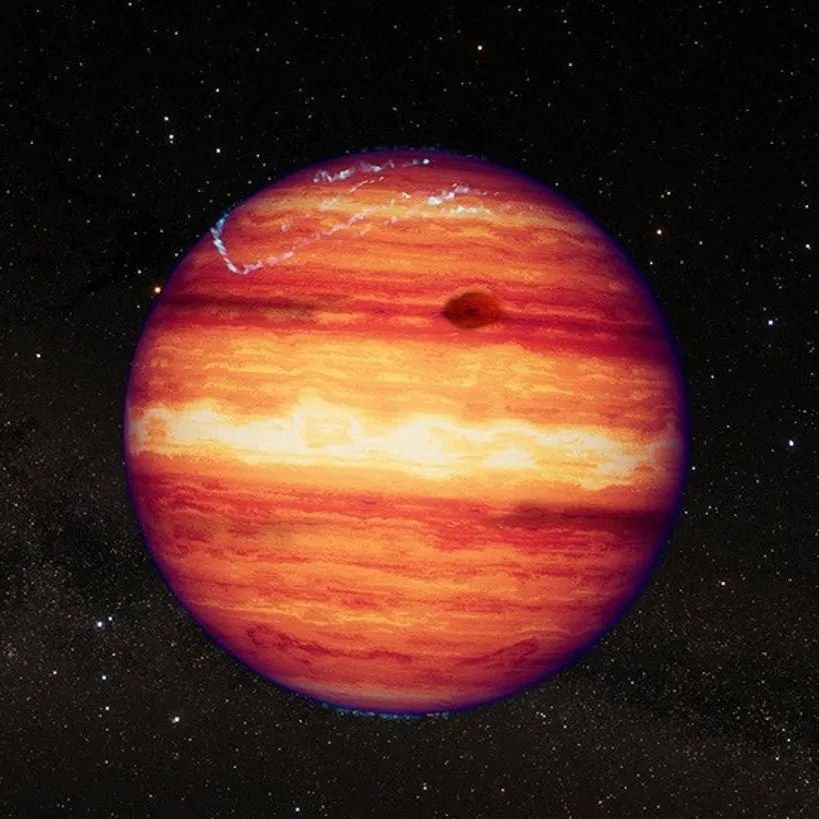
Meet SIMP 0136, a giant planet adrift in the vast darkness of space, without a star to anchor it. No sunrise, no sunset—just an endless, starless night. Unlike Earth, which enjoys a cozy relationship with the Sun, SIMP 0136 is a cosmic orphan, floating freely and unpredictably through the void. Recently scrutinized by the powerful James Webb Space Telescope, this strange world is shrouded in swirling clouds of iron and silicates, experiencing wild shifts in temperature as it roams through the interstellar abyss.
But here’s the real kicker: SIMP 0136 is not unique. In fact, there may be more of these planetary wanderers than we ever imagined. Recent studies suggest rogue planets might outnumber the stars in our galaxy. Think about that for a second—there could be billions of planets drifting untethered, lurking in the darkness, unseen and largely unknown.
What Makes a Planet Go Rogue?
Not all planets play by the rules. Some are born into chaos, forming far from any star, failing to get caught in a stable orbit. Others begin life in a planetary system, only to be flung out by gravitational encounters—perhaps an unlucky collision with a larger world or a near-miss with a passing star. One moment, they’re part of a cozy planetary family; the next, they’re exiled into the cold emptiness of space, doomed to wander indefinitely.
SIMP 0136, for example, is massive—about 13 times the size of Jupiter—blurring the line between a planet and a brown dwarf, sometimes referred to as a “failed star.” It likely formed like a star but didn’t gather enough mass to ignite nuclear fusion. That means, despite its size, it’s more of a planetary misfit than a true star.
The Strange Atmosphere of a Starless World
So what happens to a planet that doesn’t orbit a sun? Does it just sit there, frozen and lifeless? Not necessarily. SIMP 0136, for example, has an active atmosphere, with clouds of vaporized iron and silicates swirling around in ever-changing storms. It also exhibits bright spots that could be auroras—something usually associated with planets that interact with a star’s magnetic field. But since SIMP 0136 has no parent star, its auroras remain a mystery, possibly triggered by its own magnetic activity or interactions with cosmic rays.
This is just one piece of a much larger puzzle. By studying rogue planets like SIMP 0136, scientists hope to understand how planets evolve outside the traditional solar system model. What happens to their atmospheres? Could they retain heat internally for billions of years? And—perhaps the most tantalizing question—could any of them harbor life?
The Hidden Army of Rogue Planets
SIMP 0136 is just the beginning. New research suggests that rogue planets could be astonishingly common—so common, in fact, that they might outnumber the stars themselves. This means the night sky isn’t just filled with twinkling suns; it’s also populated with invisible worlds, lurking in the darkness between them.
The upcoming Nancy Grace Roman Space Telescope is expected to uncover hundreds more of these starless planets, potentially identifying Earth-sized rogues. If even a fraction of these planets have thick atmospheres or subsurface oceans, the implications for astrobiology could be staggering. Could rogue planets provide conditions for life, even without a star? Could underground thermal activity keep them warm? Scientists are eager to find out.
The Future of Rogue Planet Exploration
The discovery of SIMP 0136 and other rogue planets is rewriting what we thought we knew about planetary formation. Traditionally, planets were seen as objects bound to their stars, but the sheer number of free-floating worlds challenges that assumption.
With telescopes like JWST and future missions designed to track these cosmic wanderers, we may soon uncover more about their atmospheres, compositions, and potential for hosting alien life. It’s a reminder that space isn’t just an orderly collection of star systems—it’s also a wild, unpredictable place, where planets can exist without suns, drifting endlessly through the void.
In the end, the universe is full of surprises. For every neatly arranged solar system, there are planets out there breaking the rules, forging their own paths, and proving that even in the darkest corners of space, there’s always something new to discover.