
Nestled in the rolling hills of Kunming, Yunnan Province, China, lies a theme park like no other: the Kingdom of the Little People. Established in 2009, this unusual attraction employs individuals with dwarfism to entertain visitors through choreographed performances, fairy-tale costumes, and whimsical displays.
The Kingdom of the Little People is home to around 100 small people all under 130 cm (4ft 3in) tall, most of whom have the medical condition that causes dwarfism. It is also a theme park where tourists come to watch kitsch performances, ranging from a saucy can-can to a bizarre Swan Lake, and take photos of the tiny inhabitants as they wander round the small mushroom shaped houses.

The Kingdom was built by Chinese millionaire Chen Mingjing after chatting to two dwarfs at a train station.
“I really pitied their situation,” he says. “Their families despised them, cursed them, so they had to sleep on the street. I thought we should build a kingdom just for them.”
The workers are paid around 2,000 rmb ($320) per month for two one-hour performances per day, with lodging and meals provided by the park, which is about equivalent to a full time wage in a Chinese clothes factory.
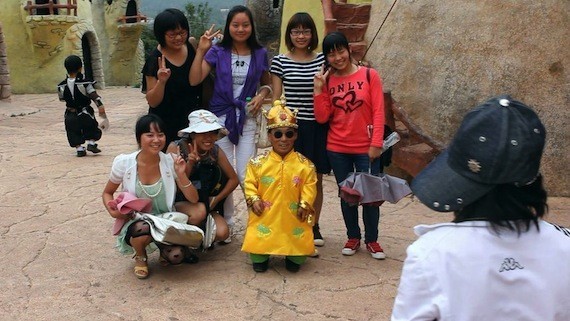
Most of them don’t actually live in the cute mushroom houses but in concrete boarding house situated at the bac of the park. They may not be aesthetically pleasing but the houses have all mod-cons and have been specifically designed for people of small height – low kitchen surfaces, small-stepped staircases, and light switches at half the standard height etc
In an ideal world people who are different would not be gawked at and prejudiced against but until that world exists this a kingdom where people with dwarfsm can live and work safely and secure.
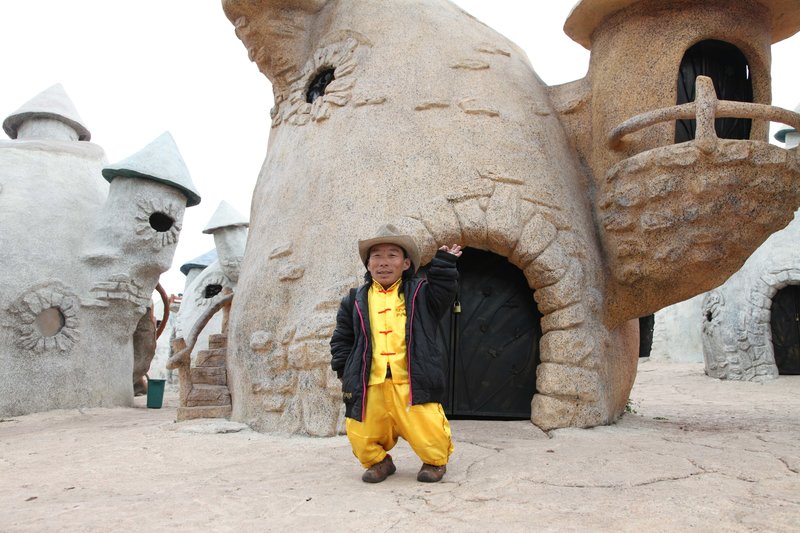
The theme park has been criticized by some as exploitative and no better than a freak show. But in a country where people with disabilities are often badly treated abused and prejudiced against, the actual inhabitants it’s a sanctuary. Many of the Kingdom’s performers come here destitute and had previously survived as street beggars.
“As soon as I arrived and saw people like me I was happy,” says Li Ying’an, 28, who married fellow performer Peng Chunsong, 24, after they met at the Kingdom.
While it’s marketed as a place of joy and fantasy, the park has sparked fierce debates around the globe, with critics labeling it exploitative and defenders highlighting its role in providing employment and community for its staff.
The Ethical Quandary
Critics of the Kingdom of the Little People argue that it’s little more than a modern-day freak show, exploiting its employees for profit while perpetuating harmful stereotypes about individuals with dwarfism. Visitors pay to gawk at the performers, many of whom are presented in ways that reduce their identities to their physical condition rather than highlighting their talents or individuality.
“It’s degrading,” says activist groups such as Little People of America. “This is not empowerment. It’s putting people on display for amusement.” Others have described it as infantilizing, with performers often dressed in cartoonish outfits and asked to participate in slapstick routines that emphasize their size rather than their abilities.
There’s also the concern that the performers, many of whom come from impoverished backgrounds, may feel they have few other options for work. In a society where people with dwarfism often face severe discrimination and limited career opportunities, critics suggest that some employees might not be choosing this path freely but out of necessity.
A Place of Opportunity?
Defenders of the Kingdom of the Little People, including some of its employees, push back against these criticisms. For many, the park provides stable employment, housing, and a sense of belonging in a world that often marginalizes them.
“Before I came here, I couldn’t find work,” says one performer. “People would stare at me in the streets. Here, I feel respected.” The park’s management claims that the performers are free to leave at any time and that they’re treated fairly, with access to healthcare and other benefits.
Some even view the park as a rare space where individuals with dwarfism are not only visible but celebrated. The performances provide a platform to challenge societal perceptions, albeit in a context that many find troubling.
The Global Perspective
The Kingdom of the Little People’s existence raises questions about the intersection of ethics, representation, and economic reality. It’s not an isolated phenomenon; other controversial enterprises, such as tourist attractions featuring ethnic minorities or people with disabilities, have sparked similar debates about exploitation versus empowerment.
For many, the problem lies in the way the park’s narrative is framed. Rather than emphasizing the performers’ artistry, the Kingdom of the Little People markets itself as a fantasy land centered around their physical differences. This framing, critics argue, undermines the very empowerment the park claims to offer.
The Broader Implications
Ultimately, the Kingdom of the Little People forces us to confront uncomfortable questions. What constitutes fair employment for marginalized groups? Can a space be simultaneously empowering for its participants and demeaning in the eyes of outsiders? Is it possible to celebrate difference without commodifying it?
Whether one views the Kingdom of the Little People as a sanctuary or a spectacle, there’s no denying it shines a spotlight on the systemic barriers faced by individuals with dwarfism. As the debate continues, the park remains a vivid, if contentious, reminder of how society grapples with diversity, dignity, and representation in an increasingly commodified world.
012018 ma xiangang