
Some stories do not begin with a crime. They begin with a question the mind almost refuses to hold.
How does a woman marry the man who tried to destroy her face?
Not metaphorically. Not emotionally. Literally. A man throws acid at a young woman after she ends their relationship. Her skin burns. Her sight is damaged. Her future is rewritten in pain, surgery, mirrors, fear. Then, later, after prison letters and pleas for forgiveness, she marries him.
This is not an urban legend passed around in the darker drains of social media. It happened to Berfin Özek, a young woman from Turkey whose case became one of those stories people share with a kind of horrified disbelief, as if forwarding it might somehow make it easier to understand. It does not.

The attack happened on 15 January 2019, in the ?skenderun district of Hatay, in southern Turkey. Berfin was 18 at the time. Her ex-boyfriend, Casim Ozan Çeltik, threw an acid-like flammable liquid at her face after their relationship ended. She was taken to hospital. He fled. The liquid burned her face and body and left her blind in one eye.
It was already a horrifying case of intimate violence. Then came the part that made it almost impossible to look at directly.
She forgave him.
Then she married him.
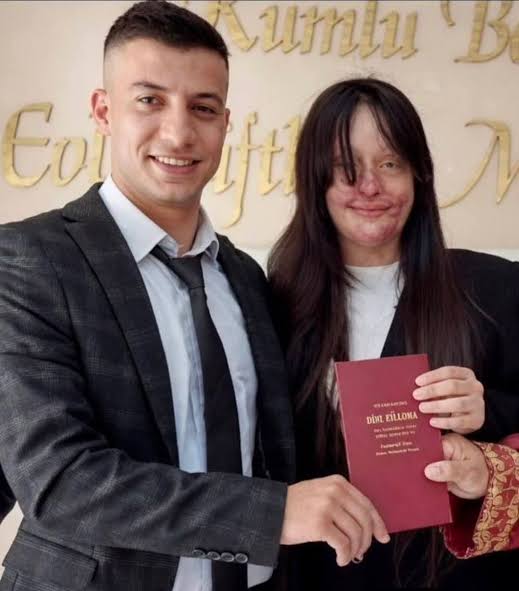
A Crime Written on the Body
Acid attacks have a particular horror. Murder ends a life; acid attempts to rewrite one. It is violence as permanent authorship. The attacker does not simply want the victim hurt. He wants the wound to remain visible. He wants the world to become his witness.
There is something ancient and sickening in that logic. The face is identity, recognition, expression, beauty, embarrassment, defiance, ordinary human weather. To attack it is not only to injure. It is to say: I will decide how the world sees you now.
In Berfin Özek’s case, the court did not treat the attack as a private argument gone too far. Çeltik was sentenced to 13 years and six months in prison. Turkish outlets reported that the conviction related to the acid attack and that prosecutors had sought a heavier punishment.
Berfin herself initially responded with pain and anger. According to reports at the time, after the sentence she questioned whether the punishment matched what had been done to her. She had lost an eye. She feared what might happen if he was ever released.
That fear matters.
Because before the later forgiveness, before the marriage, before the internet turned her life into a moral puzzle for strangers, there was a young woman who understood exactly what had happened to her.

The Letters From Prison
While Çeltik was in prison, he reportedly began sending Berfin letters. He asked for forgiveness. He said he loved her. He wanted another chance.
This is where the story becomes more disturbing than the crime itself. Not because forgiveness is impossible. Human beings forgive extraordinary things. But because, in cases of intimate violence, apology is rarely just apology. It can become part of the same machinery as the violence: pressure, persuasion, guilt, dependency, hope.
In 2020, Turkish media reported that Berfin withdrew her criminal complaint and forgave him. She also dismissed lawyers who had been supporting her case. Women’s rights campaigners reacted with alarm, and one lawyer involved in the case said they would no longer represent her after the decision.
From outside, the question seems almost insultingly obvious: why would she do that?
But abusive relationships are not always governed by the ordinary laws of attraction and revulsion. They create their own climate. Fear, guilt, longing, shame, isolation, tenderness, memory, threat and apology can all sit in the same room, wearing each other’s clothes.
The person outside the relationship sees the cage.
The person inside it may see a door that keeps changing shape.
The Wedding
In December 2021, reports emerged that Berfin Özek had married Casim Ozan Çeltik after his release under probation. The reaction was immediate and furious. Many people saw the marriage not as romance, but as evidence of trauma, coercion or a justice system that had failed to protect a victim from the man who had permanently harmed her.
Her father was reported to have opposed the marriage. Women’s rights groups condemned the wider circumstances around the case. To many observers, the wedding felt less like a happy ending than a nightmare that had learned to wear a white dress.
The viral version of the story often includes a sentence supposedly spoken before the attack: “If I can’t have you, no one can.” That line has been widely repeated in English-language retellings, though it should be treated with caution unless tied to a clear primary report. Even without it, the meaning of the attack hardly needs translation. Acid is possession in liquid form. Acid says punishment. Acid says the body is a battlefield.
The marriage was so disturbing because it appeared to complete the attacker’s logic. A man who had tried to mark a woman forever was now legally joined to the life he had damaged.
Why Would Someone Return to an Abuser?
There is no single answer. There almost never is.
Some victims return because they are afraid. Some return because they are financially trapped. Some because family, community, religion or shame closes around them like weather. Some because the abuser has convinced them that no one else will love them. Some because the good memories have not vanished, even when the bad ones should have burned everything away. Some because an apology, repeated often enough, begins to sound like rescue.
And some because trauma does not always produce clean hatred.
That is one of the bleakest truths. The human mind is not a courtroom. It does not line up evidence, weigh it rationally and deliver a verdict in polished language. It loops. It bargains. It edits. It tries to survive. Sometimes it walks back towards the source of its own suffering and calls that movement love.
None of this excuses the attacker. It only makes the victim’s choices less available to lazy judgement.
“Why didn’t she just leave?” is often the wrong question.
The better question is: what kind of psychological, social and legal conditions make leaving so hard that even horror can be repackaged as devotion?
The Dark Mechanics of Trauma Bonding
There is a term often used in discussions of abusive relationships: trauma bonding. It describes the attachment that can form when cruelty and affection are mixed together in unpredictable cycles. The same person who harms you may also comfort you. The same person who terrifies you may beg for forgiveness. The same person who destroys your safety may become the person you look to for repair.
This is not love in the sentimental sense. It is not the stuff of songs, candlelight and soft-focus redemption arcs. It is more like a faulty electrical circuit in the nervous system. Pain, relief, fear and tenderness all fire through the same wires.
The abuser says sorry.
The victim remembers the person before the violence.
The world outside becomes noisy, judgemental, impossible.
The abuser becomes familiar.
And familiarity, even terrible familiarity, can feel safer than the unknown.
That is the gruesome genius of coercive control. It does not always need chains. Sometimes it uses memory. Sometimes it uses pity. Sometimes it uses the victim’s own longing for the story to have meant something other than what it plainly meant.
Turkey’s Wider Shadow
Berfin Özek’s case struck a particular nerve in Turkey because it echoed a much older and culturally famous story: Bergen, the Turkish singer known as “the Woman of Sorrows”. Bergen was blinded in one eye after an acid attack arranged by her husband. She later divorced him, but he murdered her in 1989. Her story remains one of Turkey’s most haunting symbols of violence against women.
That shadow hung over Berfin’s case. To many people watching, this was not simply one bizarre relationship. It was part of a broader pattern: men interpreting rejection as humiliation, humiliation as injury, and women’s bodies as places where that injury can be avenged.
The monster in this story is not only the man who threw the liquid.
It is also the cultural script that teaches some men that love means ownership, that refusal is an insult, and that a woman’s face is something they have the right to punish.
The Internet’s Favourite Kind of Horror
The internet loves stories like this because they are compact. They fit inside a caption. Young woman attacked. Attacker jailed. Attacker writes letters. Woman forgives him. They marry.
Then come the comments: disbelief, disgust, amateur psychology, blame, pity, rage. Everyone becomes a detective of someone else’s pain. Everyone knows what they would have done.
But the true story is not compact. It is messy, private, culturally loaded and psychologically strange. It is not proof that love conquers all. Love did not conquer all here. Something darker did: trauma, dependency, coercion, hope, fear, denial, forgiveness, pressure — perhaps all of them braided together.
Nor is it a story about a foolish woman. That is the cheap reading. The tabloid reading. The reading that lets everyone else feel clever and safe.
The more unsettling reading is this: human beings are easier to break than we want to believe, and once broken, they do not always arrange their lives in ways that make sense to spectators.
Sometimes they go back.
Sometimes they call it forgiveness.
Sometimes they call it marriage.
The Real Horror
What happened to Berfin Özek was grotesque. But the strangest part of the story is not simply that a young woman married the man who threw acid at her.
The strangest part is that the human mind can survive the unbearable by rearranging it into a shape it can live with.
A courtroom saw a crime. Campaigners saw violence. Strangers online saw madness. Perhaps Berfin saw something else entirely: remorse, history, pressure, love, fear, fate, or some private mixture no headline could ever hold.
That does not make the marriage romantic. It makes it frightening.
Because the real horror is not that love is blind.
The real horror is that trauma can learn to speak in love’s voice.